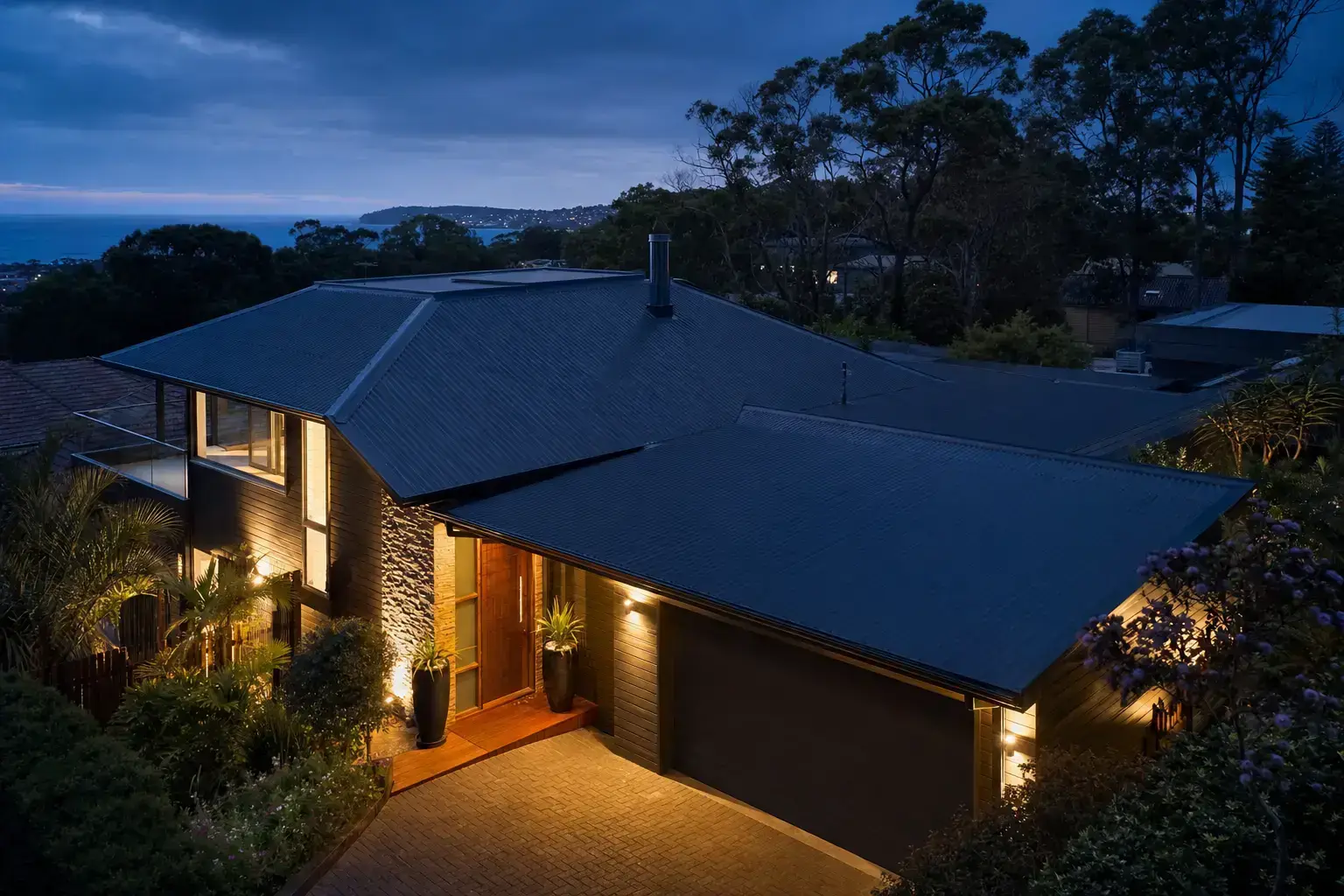
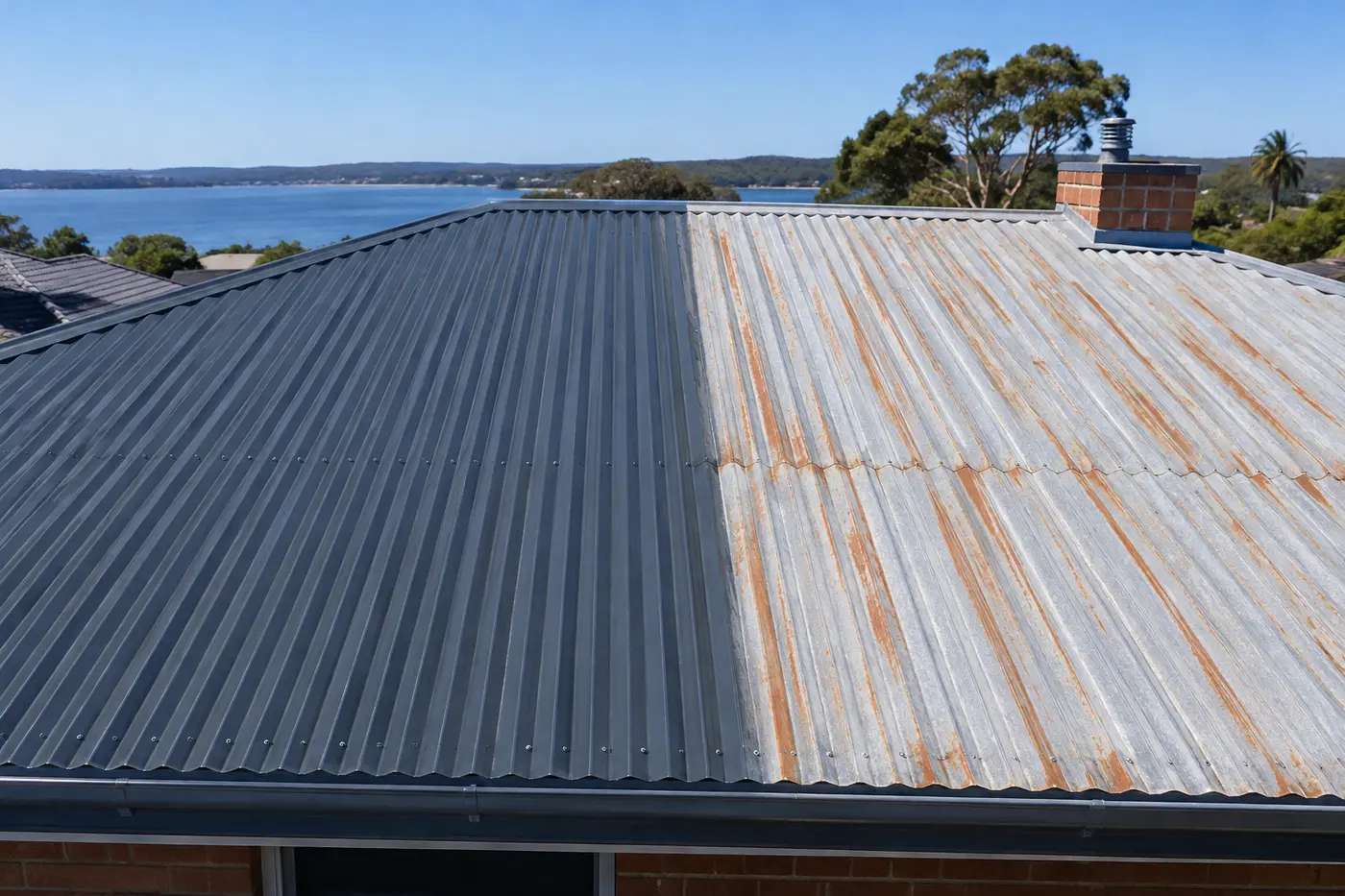
The call usually goes something like this. The Colorbond went on the house decades ago. It used to be a deep green and now it looks pale and chalky, there are orange streaks running down from a few of the screws, and the owner wants to know if they are up for a whole new roof. Most of the time, they are not. A metal roof restoration (a proper clean, rust treatment, new screws and a fresh coating) is often all an old Colorbond or corrugated iron roof on the Central Coast needs to get a long second life.
Here is what that job involves, what we check before we recommend it, and the point where we tell people to save their money for a replacement instead.
A faded metal roof is usually a surface problem
Metal roofing is built to last. Properly installed and maintained, it can go 40 years or more, even in coastal conditions. What wears out first is not the steel. It is the factory paint finish on top, the rubber seals on the screws, and the small spots where water and salt sit for too long.
Sun is behind the faded look. UV slowly breaks down the paint until it goes flat and powdery, and if you could run a hand across it you would come away with a chalky film. That is oxidation. On its own it is cosmetic, and the steel underneath can still be perfectly sound.
So the first question we answer on any metal roof is simple: is the steel still good? If it is, restoring it costs a fraction of a new roof. If it is not, no amount of paint will save it.
Screws and laps are where the trouble starts
When we walk an older metal roof, the same few things come up again and again.
- Perished screw seals. Every roofing screw has a small rubber washer under its head. UV breaks those down over 15 to 20 years, long before the steel is worn out, and a cracked washer lets water run straight down the screw.
- Rust around the fasteners. Usually the next stage. From the ground it shows as orange streaks below the screw lines.
- Rust at the laps, where one sheet overlaps the next. Leaves and grime hold moisture against the steel there, and on the coast that trapped damp is where rust tends to begin.
- Old patch jobs. Blobs of silicone, odd bits of flashing, a mismatched sheet or two. Some are fine. Some are hiding the real problem.
None of these is a disaster on its own. Surface rust caught early is a repair. Left for a few more years it eats through the sheet, and a hole means that sheet has to come off.
What a metal roof restoration actually involves
The order of the work matters more than the brand of paint. A coating is only as good as the surface it goes onto, and most failed roof paint jobs we look at were let down by poor preparation, not by the product.
- Inspect and list the repairs. We walk the whole roof, photograph what we find, and mark any sheets, flashings or valleys that need replacing before anything gets coated.
- Clean. Metal gets a controlled pressure clean. Too much pressure at the laps and screws can drive water under the sheets, so we keep it in check where it counts. The goal is to strip off grime, growth and that chalky layer so the primer can grip.
- Treat the rust. Surface rust is treated and sealed. Any sheet that has rusted through gets replaced now.
- Re-screw. Old fasteners are swapped for new sealed screws where needed. On an older roof, that is often most of them.
- Prime. Treated and bare steel gets an etch primer, which is made to bond to metal.
- Coat. Membrane topcoats made for metal and rated for coastal exposure finish the job.
If you want to see how this compares with a tile job (which adds rebedding and repointing the ridge caps), our page on tile and metal roof restoration walks through both side by side.
Price comes down to the size and pitch of the roof, how much rust there is, how many sheets and screws need replacing, and how easy the roof is to get onto. Our breakdown of roof restoration prices on the Central Coast explains how each of those moves the number.
Tile paint has no business on a steel roof
This one surprises people. Painting a metal roof is a completely different job from painting tiles: different preparation, a different primer and a different coating formula. If someone quotes the same system for every roof on the street, they are either guessing or cutting a corner.
The membrane we use is mixed to order, so it can match your original Colorbond colour if you like the house the way it is. Plenty of owners use the restoration as a chance to change it. Lighter colours hold less heat on a hot day, which is worth thinking about on a west facing block. Our coating system carries a 15-year warranty, conditions apply.
Holes in the steel mean it is time to replace
We would rather lose a restoration job than sell one that will not last. A metal roof is not worth restoring when:
- rust has gone right through in many places (holes, not just staining)
- it leaks in several spots and the sheets around them are rotting out
- the battens or frame underneath have structural damage
- it has been patched so many times there is not much original roof left
That last one comes up a lot on the Peninsula. Woy Woy has plenty of post-war cottages still wearing their original corrugated iron, much of it at or past its 60th birthday. Some of it restores well. Some of it is genuinely done, and painting it would only hide the problem for a while. If you are on the fence, our guide to choosing between restoring and replacing a roof explains how we make that call.
Salt air sets the maintenance clock
Where you live changes how hard a metal roof has to work. A house a street back from the surf at Terrigal or Avoca Beach takes far more salt than one up in Narara or Kariong, and salt is what speeds up rust at the screws, laps and cut edges.
Near the water, small habits make the biggest difference. Keep leaves out of the gutters and valleys so moisture does not sit against the steel. Get the roof looked at after a big blow, because a lifted sheet is cheap to fix before it lets water in. And plan to re-screw at around 15 to 20 years rather than waiting for a leak to tell you the seals have gone. A restored roof that gets that kind of attention will keep going for a long time.
Find out what your roof actually needs
If your metal roof has gone chalky, you can see rust streaks from the ground, or it has started leaking around the screws, get it checked before the rust gets a head start. We do a free on-site inspection with photos of everything we find, then a written quote with no obligation. Talk to our Central Coast roof restoration team and we will tell you straight whether it needs a recoat, a few new sheets or something bigger.