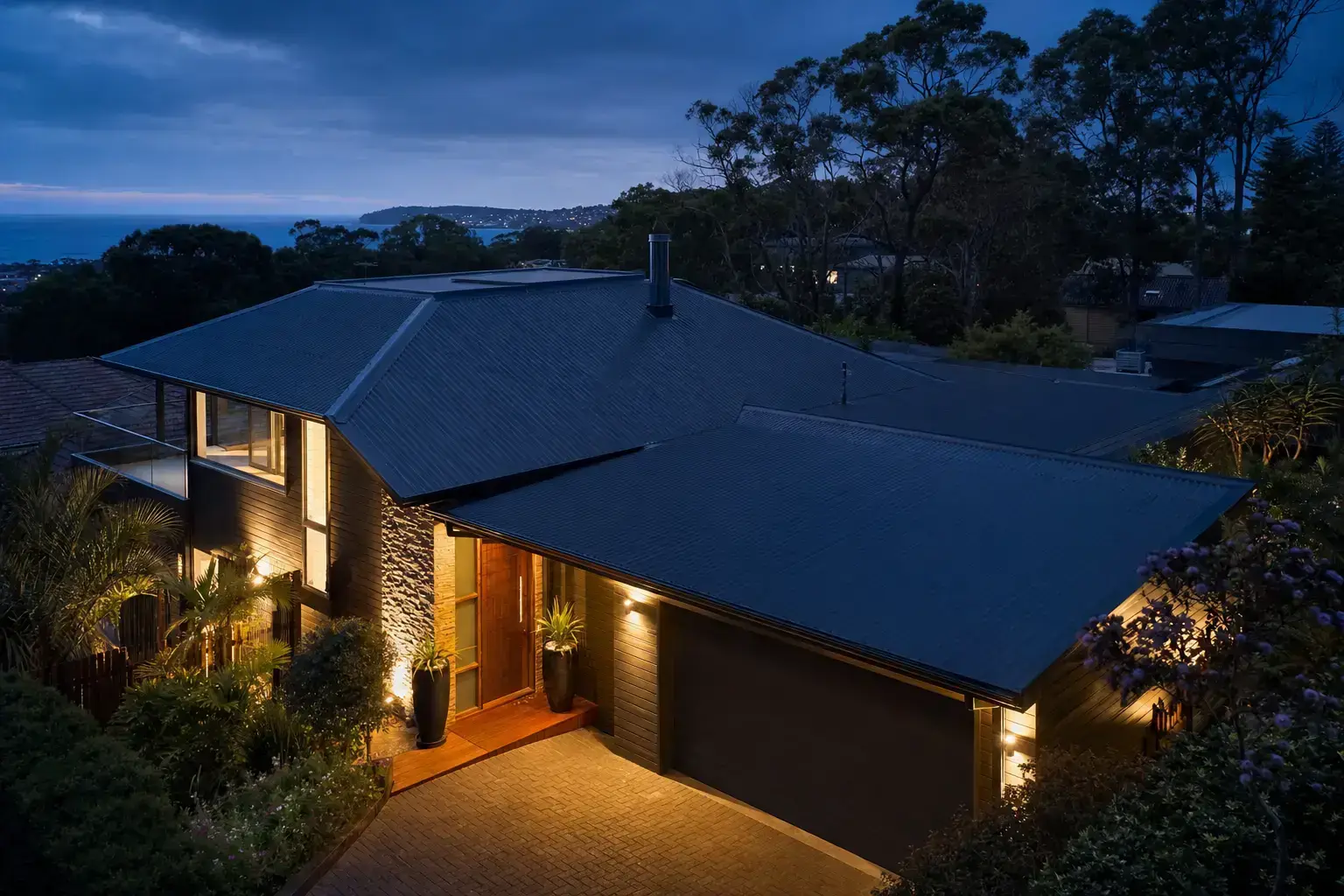
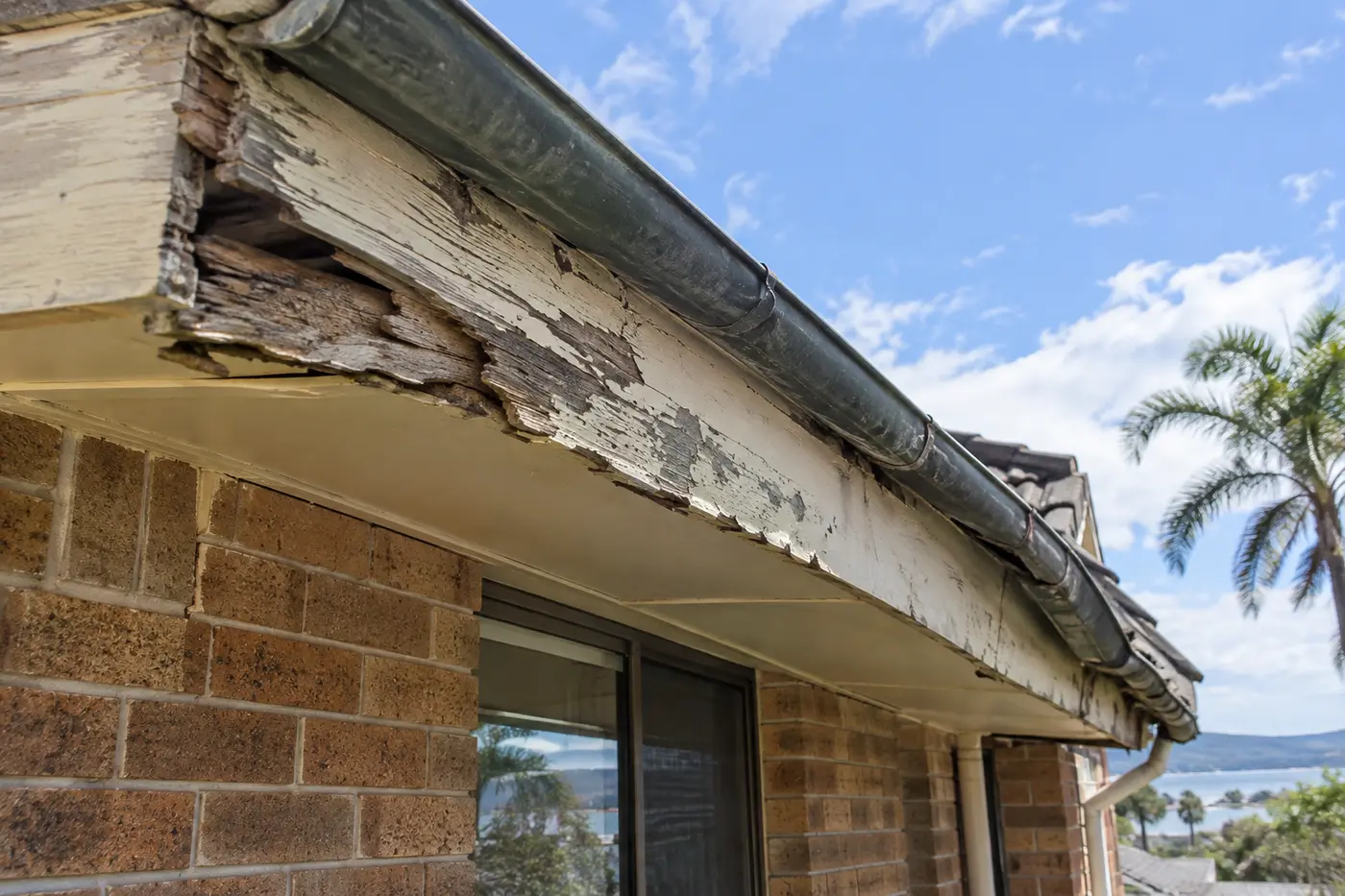
You're on the ladder clearing the gutters, you rest a hand on the board behind them, and your thumb sinks in. Or the paint along the roof edge has been peeling for a couple of summers and there's now a dark stain creeping across it. Either way, you're probably looking at fascia board replacement, and the first thing most homeowners ask us is whether the whole lot has to come off or whether it can just be covered over.
The honest answer depends on how far the rot has gone. Here is how we work that out on Central Coast homes, and what each option really involves.
The fascia is the board your gutters hang from
The fascia is the long board that runs along the edge of your roof, fixed across the ends of the rafters (the sloping timbers that hold the roof up). Your gutters are screwed to it. On a tiled roof the bottom row of tiles sits just above it, and underneath you'll find the eaves lining, the flat sheet that closes in the underside of the overhang.
On most older homes around the Coast the fascia is painted timber. Many newer homes and re-roofs have metal fascia instead. Timber is the one that rots.
Rot nearly always starts with gutter water
Fascia timber rarely fails by itself. On the homes we look at, the cause is almost always water that should have gone down a downpipe. A gutter overflows in a heavy downpour, or it has lost its fall (the slight slope that carries water to the outlet) and holds a puddle against the board for days. Water gets in behind the gutter and soaks into the back of the timber, where nobody can see it. The paint on the front is the last thing to give up.
Corners and joins go first. That's where two boards meet, the cut ends drink up water, and the paint is at its thinnest. Under the big gums and leafy streets around Kincumber, Erina and Narara, gutters fill with leaves and overflow in every storm, and we regularly find fascia there that has gone soft along whole runs.
Five signs the timber has gone soft
- Paint that blisters and peels on the same stretch every year, even after a fresh coat
- Dark stains or tide marks on the board, or on the eaves lining below it
- A gutter that sags or pulls away, or bracket screws that spin without biting
- Gaps at the corners where birds, rats or possums are getting into the roof space
- Timber that crumbles or feels spongy when pressed
One of these is worth a closer look. Two or more, and in our experience the rot usually runs further along the board than it looks from the ground.
Replace or cover? Often it's both
Most people searching this have come across Colorbond fascia covers. These are folded metal covers that fit over the existing timber, made in a colour to match your roof and gutters. Once they're on, there's no more painting. It's a good product, and we fit plenty of them.
The catch is what's underneath. A cover hides timber. It doesn't fix it. Cap a board that's already soft and wet and the rot carries on in the dark, the gutter brackets slowly lose their grip, and eventually the gutter comes away with the rotten board still sitting behind clean new metal. Covering rot without fixing it just hides the problem while it spreads, and we don't do it.
So the real decision comes down to what we find when we get up close.
Sound timber: cover it and stop painting
If the board is solid and only the paint is tired, a cover is often the simplest long term answer. It keeps the weather off the timber and ends the scrape and repaint routine that coastal sun and salt air make so frequent.
Soft patches: cut out, splice in, then cover
This is the job we quote most. The rotten sections, usually at the corners and joins, are cut out and new timber goes in. Once the whole run is sound again, it can be painted or capped.
Rot end to end: full replacement
When the board is soft along its length, or the rafter ends behind it have started to go as well, the fascia comes off completely. That means the gutters come off too, which changes what makes sense to do next.
Fascia and gutters are one job, not two
A fascia board can't be replaced with a gutter still hanging off it. If your gutters are already rusty, leaking at the joints or overflowing because they're too small, doing both at once means you only pay for the gutters to come down once.
It works the other way too. Whenever we replace gutters, the fascia gets checked for rot while it's exposed, then repaired or capped as needed. That's why our gutter and fascia repair service quotes the two side by side, so you can see each part of the job separately. If new gutters are on the cards, our guide to what a new set of gutters costs explains what drives that side of the price.
The same applies if you're replacing the roof. New gutters and fascia covers are listed as separate options in every roof replacement quote we write, so you can decide on them with the full picture in front of you.
The rot you can't see sets the price
We won't give a figure for fascia work over the phone, because it depends on what's behind the paint. These are the things that move the price most:
- how much timber is actually rotten once the gutter is off and the board is opened up
- whether the same water has damaged the eaves lining or the rafter ends
- single or two-storey, and how safely the roof edge can be reached
- whether new gutters are going on at the same time
- covers or paint as the finish
For a sense of what waiting costs: the typical repair bill we list for rotted fascia and eaves linings caused by overflowing gutters is $1,500 to $5,000. A single storey gutter clean, the thing that prevents most of it, is listed at $200 to $450. Rot doesn't stop on its own, so catching a soft corner early nearly always costs less than replacing a whole run later.
Older homes: know what the eaves are made of first
The Central Coast grew fast from the 1940s through to the 1980s, and asbestos cement went into fibro wall sheeting, roofs and eaves right across the region. If your home is from that era, the eaves lining sitting against the fascia may be fibro, and it shouldn't be cut, drilled or snapped off to get at the timber.
We check for this before any fascia work starts. If the lining is suspect, it gets tested and handled properly rather than guessed at. Our post on asbestos roofs and fibro on Central Coast homes explains how testing and licensed removal work in NSW.
Get the fascia checked before the next big rain
If your fascia is peeling, stained or soft in places, the useful next step is someone looking at it up close with the gutter in view. Our inspections are free, come with photos so you can see what we saw, and end in a written quote with no obligation. Book one through our gutters, fascia and downpipes page and we'll tell you straight whether your timber needs replacing, patching or just a cover.