A strong wind comes through overnight. Next morning there are little chips of grey or orange mortar on the driveway, or in the gutter when you clean it out, and one of the curved tiles along the top of the roof looks a bit crooked from the street. That is usually the first sign a home needs ridge capping repair, and it's one of the most common calls we get on the Central Coast.
The good news is that it's normally caught early. The question is which fix your roof needs, because there are two quite different jobs that both get called "fixing the ridge capping", and paying for the wrong one is how people end up calling a roofer back two winters later.
Ridge caps are held down by mortar, not nails
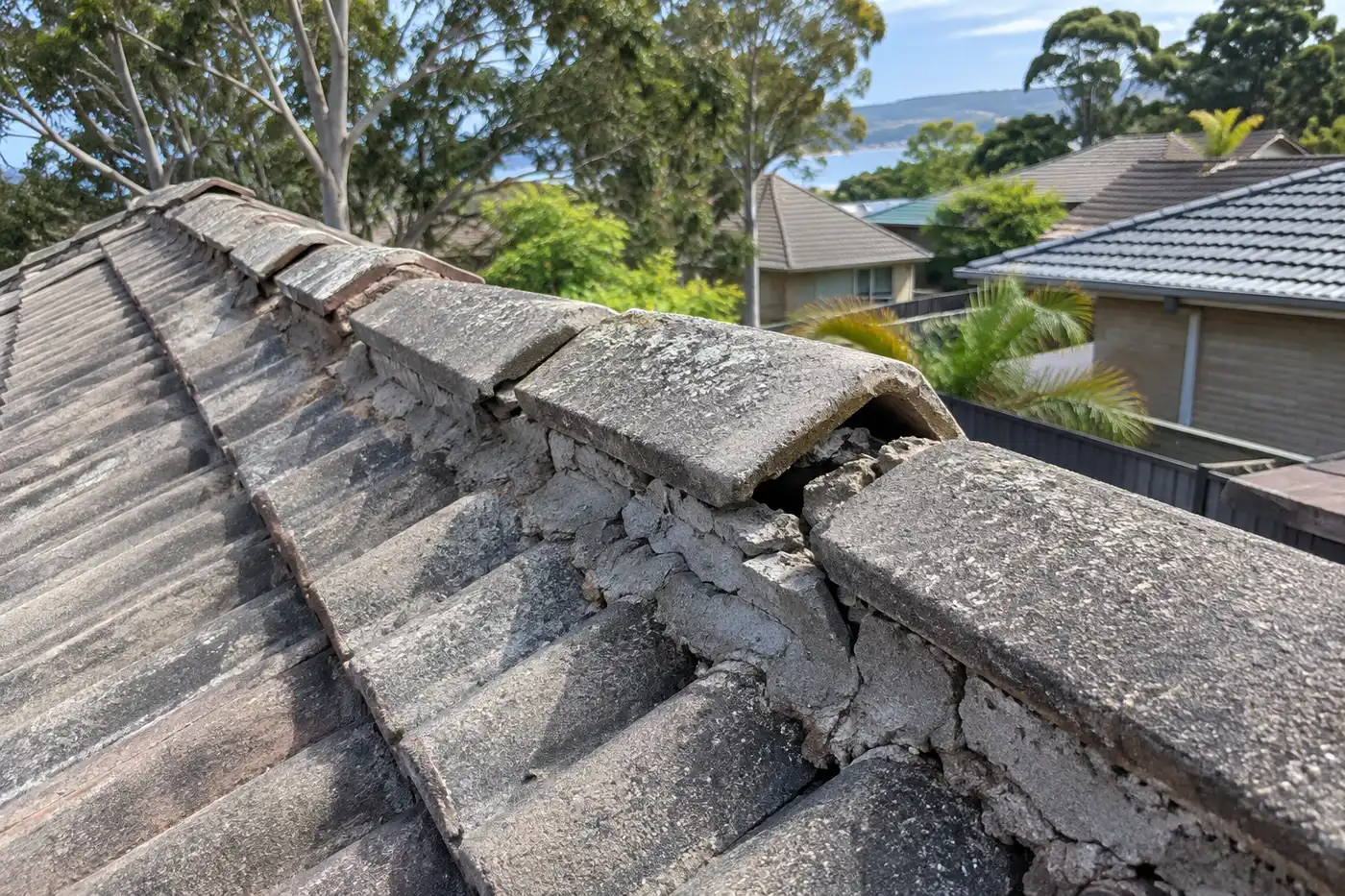
On a tiled roof, the ridge caps are the rounded tiles that run along the peak and down each hip (the sloping lines where two roof faces meet). They sit over the gap where the tiles on each side come together. On most older Central Coast homes they aren't screwed or nailed down at all. They're held in place by a bed of sand and cement mortar underneath, called the bedding.
Over the top of that bedding sits a thin finishing layer along each side of the cap, called the pointing. Its job is to seal the joint and keep water out of the bedding. When people say their "ridge cement is cracking", the pointing is usually what they can see.
Both layers wear out. Old style mortar is rigid, and a roof moves every day as it heats up and cools down. Add salt air, driving rain and plenty of sun, and after enough years the mortar shrinks, cracks and starts letting go.
Most of the warning signs are visible from the ground
You can see most of the warning signs without getting off the ground. Look for:
- mortar crumbs or grit in the gutters, on paths or under the eaves
- ridge caps that aren't in a straight line, or one that has slipped down the hip
- visible gaps or dark lines under the edges of the caps
- moss or lichen growing thickly along the ridge line
- a ceiling stain near the middle of the house, or along the line of a hip
That last one catches people out. Water that gets in under a ridge cap can run along a batten or the sarking before it drops onto the ceiling, so the stain is often a metre or two away from the actual gap. If you've got a stain and aren't sure where it's coming from, our guide on the usual causes of a leaking roof covers the other suspects too.
Repointing fixes the surface, rebedding fixes the foundation
This is the decision that matters most, and it's the one that's hardest to judge from the ground.
Repointing means cleaning off the old, loose pointing and applying a fresh flexible pointing compound along both sides of each cap. Modern flexible pointing moves with the roof rather than cracking the way old cement did. It's the right job when the bedding underneath is still solid and the caps don't move when you press on them.
Rebedding goes further. The caps are lifted off, the old bedding is chipped away, the caps are relaid on fresh mortar so they sit straight and firm, and then the whole line is pointed. It takes longer and costs more, and it's the only proper fix when the bedding itself has crumbled.
Here's the trap. A loose cap with fresh pointing smeared over the top looks perfect from the street for a while. But the pointing is only a seal. It can't hold a cap down on its own, so the next big wind rocks the cap, the new pointing cracks, and you're back where you started. When we inspect a ridge, we press on every cap. The ones that move get rebedded. The ones that are solid only need repointing.
On a lot of roofs the answer is a mix of both: rebed the worst run, often on the most exposed side, and repoint the rest.
Metal roofs have ridge capping problems of their own
On a Colorbond or Zincalume roof the ridge capping is a folded strip of steel screwed down through the high points of the roof sheets. There's no mortar to crack, so the faults look different:
- screws that have backed out or rusted, letting the cap lift in wind
- perished rubber washers under the screw heads, which let water in around each screw
- rust along the capping, especially on older roofs close to the beach
- missing or damaged foam closure strips under the cap
The fix is usually replacing screws and washers, refixing the capping, and replacing any sections that have rusted through. Because the caps are screwed rather than bedded, metal ridge repairs tend to be quicker. The catch is that rust rarely stops at the capping, so we check the sheets and flashings nearby while we're up there.
Coastal exposure wears ridge lines out faster
The ridge is the highest, most exposed part of any roof. It takes the full force of every wind change and every storm. On homes near the water, from Umina Beach up to Toukley, it also gets a steady coat of salt.
The side of the ridge that faces the weather usually takes the worst of it. That's also why we don't recommend patching one cap and walking away. Pointing tends to fail across a roof at a similar rate, so if one section has gone, the rest usually isn't far behind.
The price depends on the length of the ridge, not the size of the house
Ridge work is priced mostly by the metres of capping involved, so a simple gable roof costs less than a house with lots of hips, even if the floor area is the same. Rebedding costs more than repointing because there's far more labour in it. Steep pitches and two storey homes need extra safety setup, and matching older or discontinued cap profiles can add time.
We go into each of those factors in more detail in our guide to what drives roof repointing cost on the Coast. The short version is that a ridge repair is one of the cheaper jobs on a tiled roof, and much cheaper than repairing ceilings, insulation and timbers after a few years of slow leaks.
Sometimes the ridge is a sign the whole roof needs attention
If the tiles themselves are sound and the only problem is the mortar, a ridge repair on its own is good value. But if the inspection also finds faded, porous tiles, cracked tiles in numbers, or moss across whole slopes, the ridge is just the first thing to fail. In that case a restoration, which includes repointing as one of its steps, can make more sense than paying for repairs one at a time. We'll tell you honestly which camp your roof is in.
Either way, please don't go up to look at the ridge yourself. It's the highest and steepest point on the roof, old tiles crack underfoot, and a walk across them can create the very leak you're trying to fix. Our team handles ridge capping and tile roof repairs right across the Central Coast with the right access and safety gear.
Get the ridge checked before the next big wind
We'll walk the whole roof, press on every cap, and give you a written report with photos showing exactly what's loose, what's cracked and what's still sound. The inspection is free with no obligation, and we're licensed (NSW Licence #203374C). To book, see our roof repair service or call us in Kincumber on (02) 4326 0722.