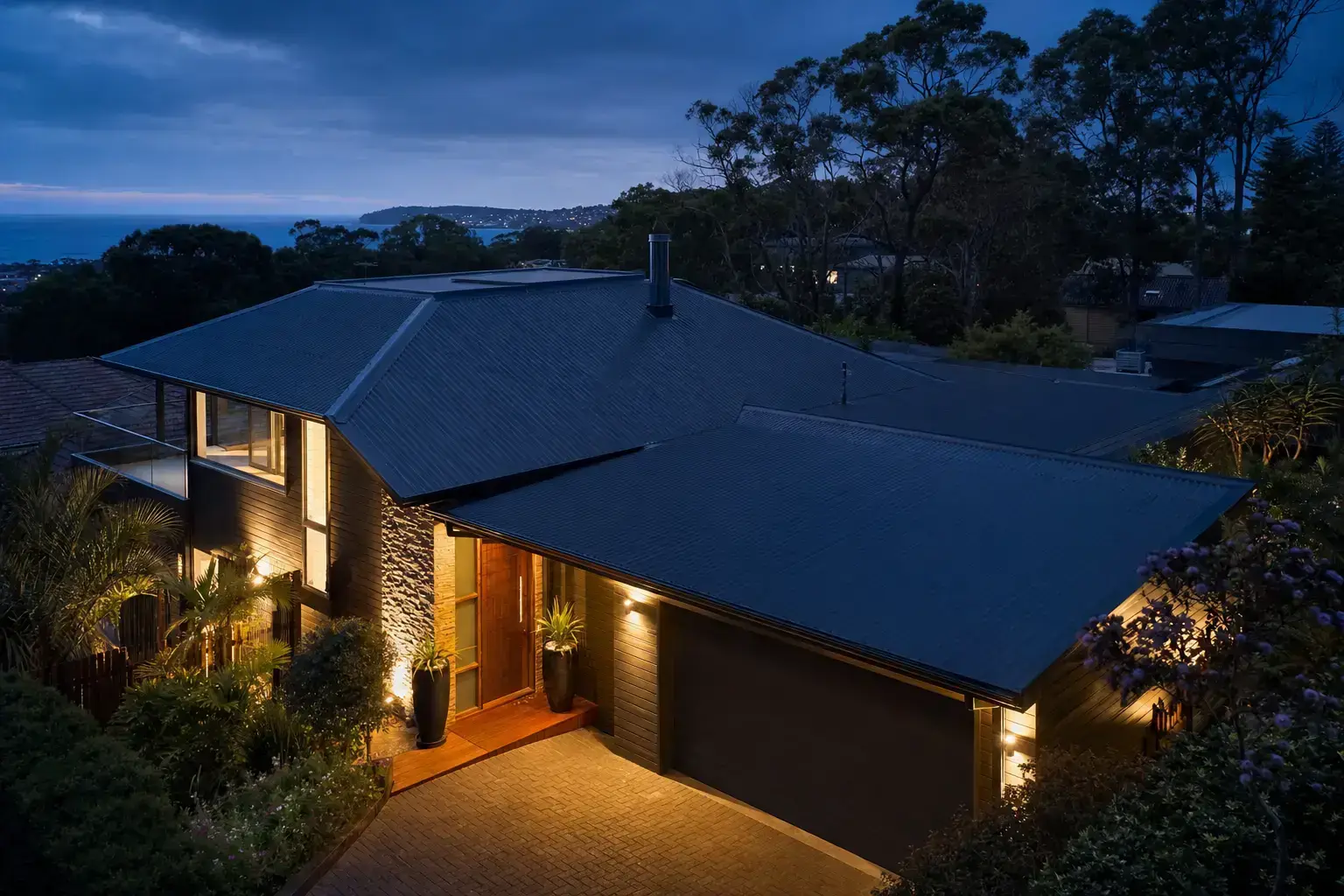
The call usually goes something like this. The ceiling is fine for months, then a southerly or a big easterly comes through and a damp patch appears near the chimney, or in the corner where the patio roof meets the house. By the next dry week it has faded, and you start to wonder if you imagined it. You did not. A leak that comes and goes with the wind is very often a flashing problem, and roof flashing repair is one of the most common jobs we do on Central Coast homes.
This guide explains what flashing is, how to tell when it has failed, and what a proper repair involves, so you know what to expect before anyone climbs a ladder.
Flashing seals every join the tiles cannot cover
Tiles and metal sheets are good at shedding water across an open slope. They are hopeless at sealing a join. Anywhere the roof meets something else, such as a wall, a chimney, a skylight, a vent pipe or an extension roof, there is a gap that rain would happily run into.
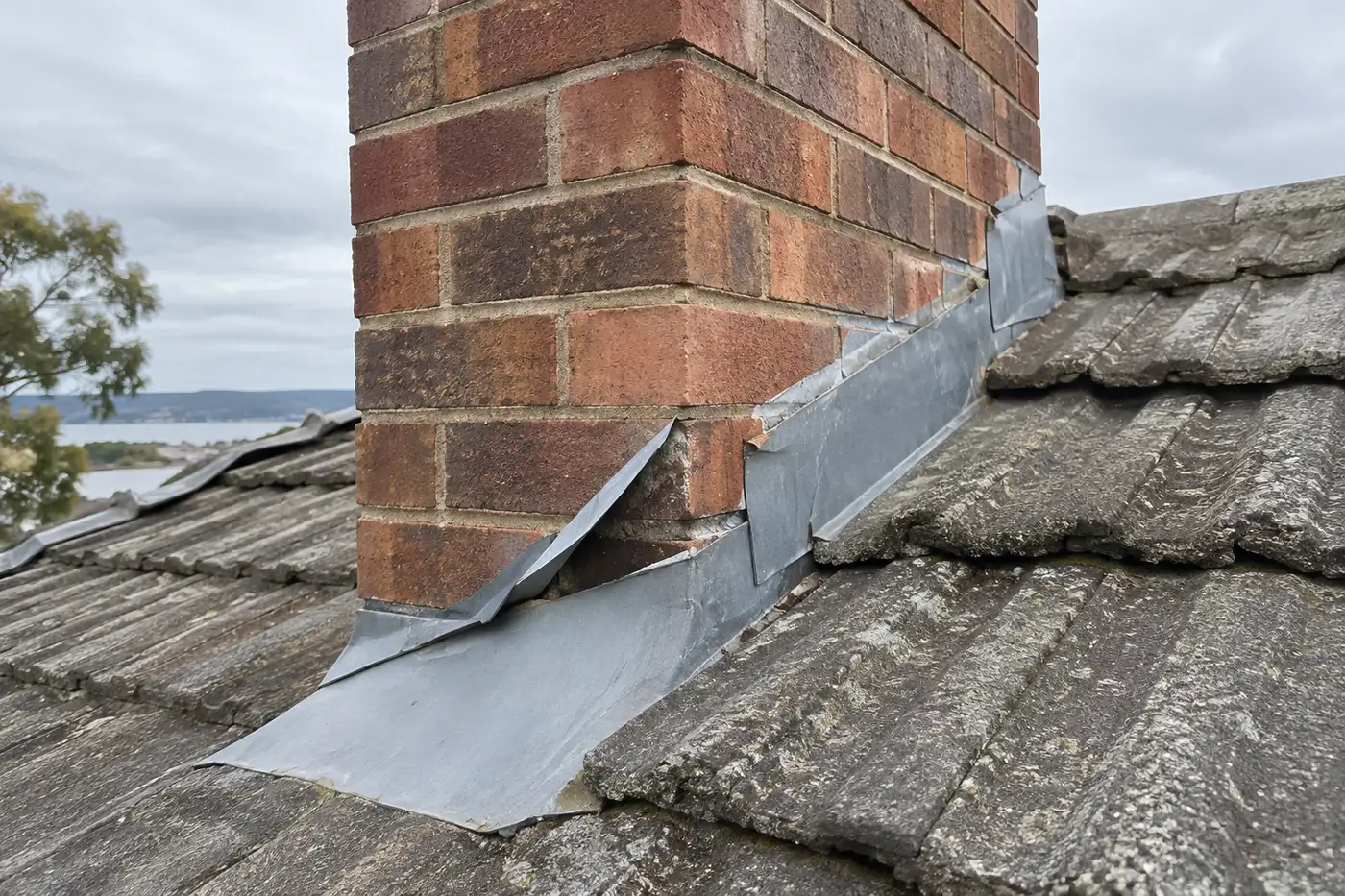
Flashing is what closes that gap. It is a strip of metal (or, on some newer work, a flexible material) shaped to lap over the roof and turn up against the wall or penetration, so water is steered back out onto the roof surface. On an older Central Coast tile roof you will typically find it:
- Along the top and sides of the chimney
- Where a second storey wall rises off a lower roof
- Around skylights, flues and vent pipes
- Where a patio or carport roof is joined to the house
None of these is visible from inside, which is why flashing faults get missed for so long.
The signs usually show up inside first
Because water travels along battens and rafters before it drips, the stain is rarely right under the fault. Still, flashing leaks have a pattern. The damp patch tends to sit near an outside wall, a chimney breast or a skylight shaft. It appears in wind driven rain and stays dry in a steady vertical downpour. Sometimes you will see bubbling paint or a brown tide mark on the chimney breast itself.
From the ground, it is worth a look with binoculars after a storm. A strip that has lifted away from the brickwork, mortar or sealant that has cracked out along the top edge, or rust streaks running down the tiles below a flashing are all signs it is no longer doing its job. If the leak does not fit that pattern, our guide to the other usual causes of a roof leak covers tiles, ridge capping and valleys.
Why flashings fail on Coast roofs
In our experience it is rarely one dramatic event. It is usually one of these, quietly working away for years.
Salt air. Close to the beach, salt settles on metal and holds moisture against it. Flashings in sheltered spots that rain never rinses, such as tucked under a wall overhang, corrode well before the open parts of the roof do.
Mixed metals. Lead or copper sitting against steel sets up galvanic corrosion, where one metal eats the other. Older houses often have lead flashing that has been sitting on newer steel for years, and the steel is losing.
Perished sealant and mortar. The top edge of a wall or chimney flashing is often tucked into a mortar joint or held with sealant. Sun and movement crack it over time, and once the top edge opens, water runs straight down behind the flashing.
It was never done properly. This one surprises people. A fair share of the flashing faults we find were wrong from day one: too short, lapped the wrong way, or simply missing where an extension was added.
Old patch jobs. A bead of silicone run along a lifted flashing might hold for a season. Then it splits, traps water behind the metal, and the leak returns.
Repair or replace comes down to the metal
If the flashing itself is sound and the problem is a lifted edge or tired sealant, a repair is usually all it needs. That means refixing it, re-forming it to sit tight, and resealing the top edge with a material that suits the wall and the metal.
If the metal is rusted through, the wrong material, or badly shaped in the first place, patching it is wasted money. A new flashing is made up to fit, lapped correctly, and kept apart from any metal it could react with. The same applies near the beach, where the replacement should be in a grade that matches the exposure, with fasteners to suit.
Sometimes a failed flashing is one sign among several. If the ridge pointing is cracking and the valleys are rusting at the same time, the honest advice may be a restoration that deals with everything at once. We would rather tell you that than fix one join and have you call us back after the next storm. Our flashing and leak repairs across the Central Coast start with that whole roof view.
What a proper flashing repair looks like
You should expect the roofer to find the actual entry point before fixing anything. That means starting at the stain inside, then checking the roof above and uphill of it, including every flashing, tile and penetration nearby. Replacing a flashing that was not the cause leaves you with a new flashing and the same leak.
Once it is fixed, ask for photos of the before and after. Flashing work sits on the roof where you will never see it, so photos are the only way to know what was done. We take them on every repair and explain what we found in plain English.
Flashing work is also not a job for a ladder and a tube of sealant. It means working at the edge of walls and chimneys, often on a steep or two storey roof, and the hard part is diagnosis rather than the repair itself.
What flashing repair costs
Our indicative range for flashing repair or replacement is $350 to $800. Every job is quoted in writing after a free inspection, and plenty come in at the lower end. Access, roof height, the number of faults and whether the flashing can be repaired or must be remade all move the price. A chimney on a steep two storey roof sits at the other end from a lifted patio flashing on a single storey home.
If you are trying to budget for a leak more broadly, our breakdown of what the common leak repairs cost sets the flashing figure beside tiles, ridge capping and valleys.
A small leak keeps getting bigger underneath
A flashing leak that only shows in heavy weather is easy to put off. The trouble is that every wet spell soaks the same timber, insulation and plasterboard, and those repairs are separate from the roof work. The roof repair might stay modest. The damage inside does not. If a damp patch keeps coming back near a wall, chimney or skylight, get it checked before the next run of storms.
Get the flashing checked properly
Call Roof Restorations & Replacements Central Coast on (02) 4326 0722 (NSW Licence #203374C), Monday to Saturday, 7am to 5pm. We will trace where the water is getting in, show you photos, and give you a written quote. The inspection and quote are free, with no obligation, and you can read more about how we handle roof repairs before you call.