There is a bucket in the hallway, a stain on the ceiling, and a question sitting underneath both of them: how much is this going to cost? It is the first thing most people ask us when they ring about a leak, and it is a fair one. The honest answer on roof leak repair cost for Central Coast homes is that most leaks are fixed for a few hundred dollars. Some are not. What separates the two is almost never the size of the drip. It is what caused it, and how long the water has been getting in.
This guide sets out the price ranges we actually quote, what moves a job up or down, and the point where paying for another patch stops being good value.
Most leak repairs land in the hundreds, not the thousands
These are the indicative ranges for the repairs behind most of the leaks we trace on the Coast. Every job is quoted in writing after a free inspection, and plenty come in at the lower end:
- Replacing broken or slipped tiles: $250 to $450
- Repointing a section of ridge capping: $300 to $600
- Leak detection plus the repair: $300 to $900
- Flashing repair or replacement: $350 to $800
- Valley iron replacement: $600 to $1,500
If you are comparing those figures with a price you found online, check what the other number includes. A quote that covers only the visible fix, with no time allowed to find where the water is really coming in, can look cheaper on paper and cost more by the second storm.
Finding the leak is part of what you pay for
Water rarely drips straight down from the fault. It gets in at one spot, runs along a batten or rafter, and shows up on the ceiling somewhere else, sometimes a couple of metres away. So the real work on a leak job is often the tracing: starting at the stain, walking the roof above and uphill of it, checking every tile, ridge cap, flashing and penetration until the true entry point turns up. That is why leak detection and repair is priced as one job rather than two.
It also explains why two leaks that look identical from inside can cost quite different amounts. One turns out to be a single cracked tile. The other is a flashing around a chimney that was never sealed properly in the first place. If you want to understand the usual causes before anyone climbs up, our guide on what is behind most roof leaks runs through them.
What pushes a quote up
The repair itself is only part of the price. These are the things that most often move a leak quote towards the top of its range, or past it:
- Access and height. A steep two storey roof takes more time and more safety gear than a low single storey one.
- More than one fault. Older roofs often have a cracked tile, tired pointing and a lifted flashing all at once. Fixing only one of them rarely stops the leak.
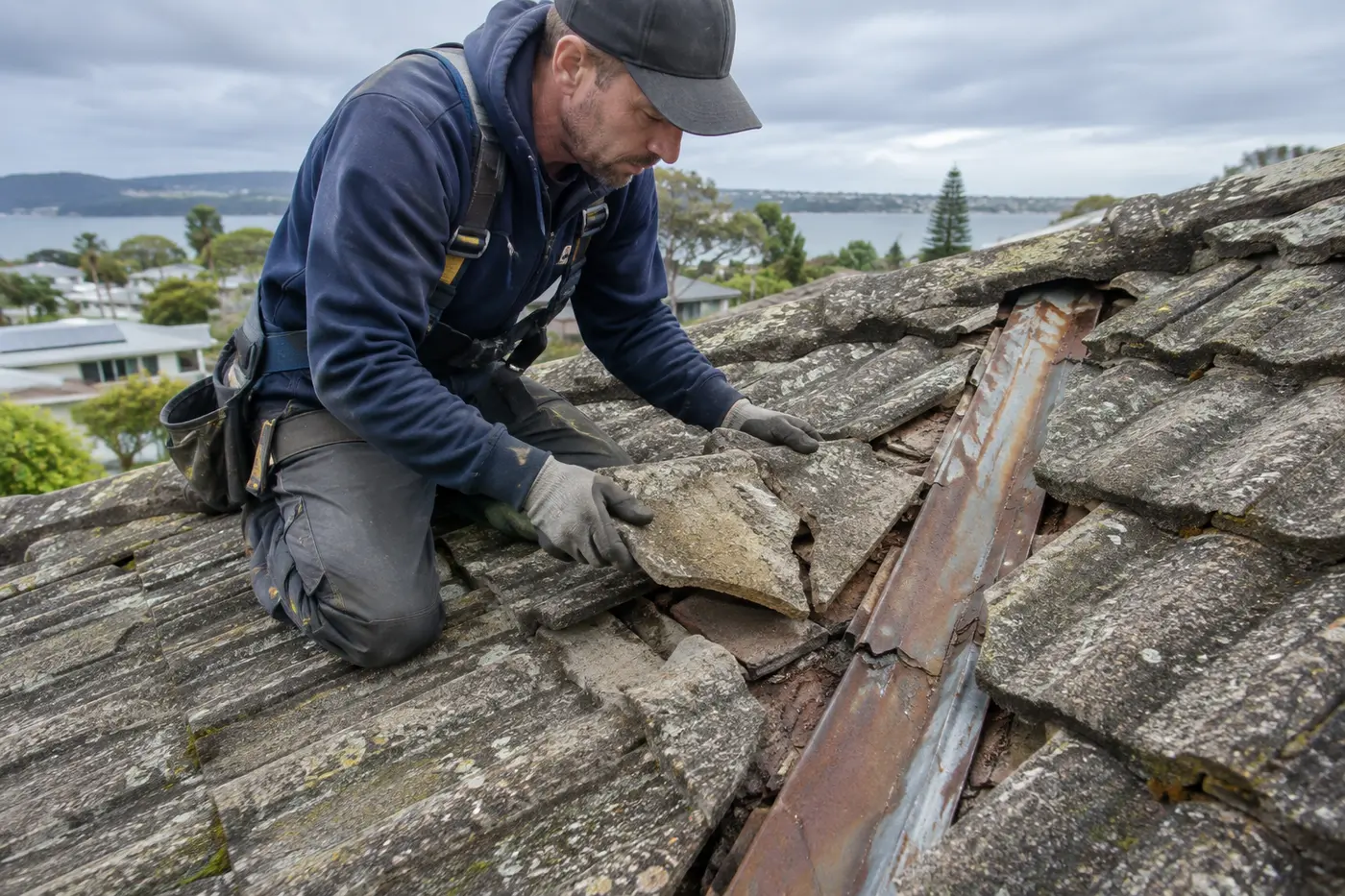
- Rusted valleys. Valley irons are the metal channels where two roof slopes meet. Once they rust through they need replacing, not patching, which is why they sit in the highest bracket.
- Wind driven leaks. A leak that only appears in heavy easterly rain usually means water is being pushed past aged flashing or pointing. These take longer to pin down.
- Time. The longer water gets in, the more it soaks timber, insulation and plaster. The roof repair might still be modest, but the damage underneath grows every wet week.
That last point matters for your budget. Replacing a sagging ceiling sheet or treating mould is separate work from fixing the roof, and it is the part of the bill that gets bigger the longer a leak is left.
Cheap fixes are the expensive ones
A surprising share of our repair work is fixing earlier repairs. The classic is a tube of silicone run over a cracked tile. It holds for about one season, then it traps water under the tile instead of letting it drain, and the leak comes back worse. We see it right across the Coast, and constantly in suburbs like Toukley where generations of handy owners have patched their own roofs.
The same goes for a repair that treats the symptom. Sealant slapped over the obvious crack, while the real entry point is an old flashing two metres uphill, means paying twice. The first repair done properly is nearly always the cheapest one you will buy. Our Central Coast roof repair service works on that basis: find the cause, fix it, photograph it, and explain in plain English what was done.
When another patch is money wasted
If a $400 repair will genuinely sort your roof for years, that is what we will recommend. We would much rather do that than talk you into something bigger.
But some leaks are the first sign of a roof that has reached the end of a cycle. The pointing is cracking along every ridge, the tiles have gone porous, and the valleys are rusting at the same time. Patch one spot on a roof like that and the next leak simply appears a few tiles along. When you find yourself calling a roofer after every big storm, it is worth stepping back and pricing the whole roof instead. A restoration deals with all of those tired parts in one go, and our guide to what a roof restoration costs on the Central Coast gives you realistic figures to weigh against a string of repair bills.
We see this a lot on 1970s and 80s concrete tile roofs, where the original valley irons and pointing are wearing out together. An inspection with photos will show you which situation you are in, with the repair, restore and replace options priced side by side.
If a storm caused it, check your insurance first
A leak that appeared the night of a big storm, on a roof that was dry the week before, may not be yours to pay for. Home insurance often covers sudden storm damage and the water damage that follows. It usually does not cover a leak that crept in through age or wear. Our article on making a roof leak insurance claim explains where insurers draw that line.
Two practical points if you are going down that path. Photograph the ceiling damage as soon as it appears, because timestamps help. And do not accept a cash settlement figure before a roofer has actually been on the roof, since the true scope of storm damage is often bigger than it looks from the ground.
How a leak quote actually works
Our inspections are free. We look at the roof, trace the water, and then give you a price in writing for the repair it needs. No hourly meter running, and if we find something outside that quote once we are on the roof, we show you and ask before doing it. For an active leak we usually get there within days, and if the weather is bad we can do a temporary make safe straight away so the damage stops spreading while the proper repair is organised.
If the leak turns out to be a symptom of something bigger, we tell you, with photos, and let you decide. Repairs are backed by our workmanship guarantee, and what was done goes in writing so you know exactly what you paid for.
Get a written price before the next heavy rain
A leak is cheapest to fix the week you notice it. If you have a stain spreading or a drip you cannot explain, contact Roof Restorations & Replacements Central Coast on (02) 4326 0722 (NSW Licence #203374C) to book a free leak inspection and written repair quote anywhere on the Coast.