A flyer lands in the letterbox offering roof sealing for your street, this week only. Or a neighbour mentions they had their tiles sealed and the roof looks brand new. Either way, you now want to know what roof sealing actually is, whether your Central Coast roof needs it, and whether it will stop that damp patch on the bedroom ceiling.
The short answer: sealing is a real and useful step, but it's one layer of a job, not the whole job. Here is how we explain it to homeowners when we're standing in their driveway.
"Roof sealing" can mean four different jobs
Part of the confusion is that the phrase gets used loosely. When someone quotes you for sealing, they could mean any of these:
- A clear tile sealer. A transparent liquid sprayed onto clean tiles so they shed water. No colour change.
- A primer/sealer coat, the first coat of a roof coating system, which soaks into the surface and gives the colour coats something to grip
- A membrane coating: thick, flexible colour coats that form a skin over the whole roof. Some companies call the entire paint job "sealing".
- Sealant on a leak, usually a bead of silicone in a crack, a lap or around a flashing
These are very different jobs at very different prices. Before you compare two quotes, find out which one each company is talking about. If nobody can give you a straight answer, treat that as the answer.
Old concrete tiles lose their skin, and that's what sealing fixes
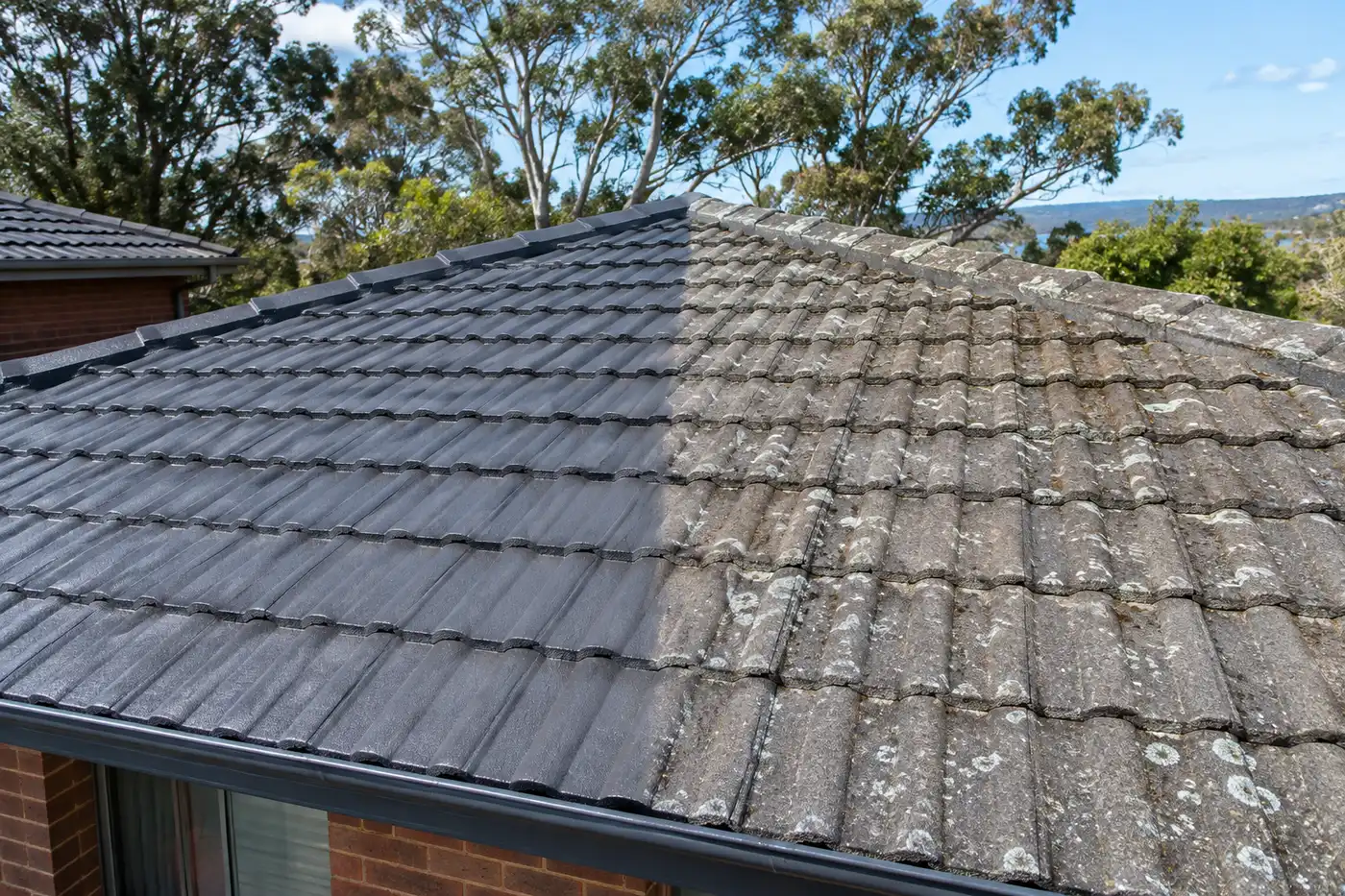
Most tile roofs on the Coast are concrete. When they're new, the surface has a coloured coating that sheds water. After a couple of decades of sun, salt air and moss, that surface wears away and the tile underneath turns porous, meaning it soaks water in rather than letting it run off. You can spot it on plenty of older roofs: patchy, faded tiles that stay dark for hours after rain, often with lichen growing in the damp spots.
A porous tile rarely leaks straight through into your ceiling. What it does is hold moisture, grow moss and lichen faster, and lose a little more of its surface every year. This is where a proper sealer earns its keep. Our primer/sealer coat goes on after a deep clean and any repairs. It soaks into the tile and locks the surface down so it stops drinking water.
Sealing won't fix a leak that starts somewhere else
This is the part that catches people out. Most of the leaks we trace on Central Coast homes don't come through the face of a tile. They come in at the weak points: cracked mortar under the ridge caps, a rusted valley iron, a lifted flashing, a cracked or slipped tile. A sealer sprayed over the top does nothing for any of those. The water still finds the same gap.
So the order of work matters. On a tile roof we replace broken tiles, sort out the valleys and flashings, and check the ridge caps first. If the old mortar is cracking, the caps need rebedding and fresh flexible pointing before anything gets sprayed. Seal over loose caps and you've simply glued the problem in place for a while.
A blob of silicone is a patch, not a repair
We find silicone on a lot of roofs. Squeezed into a cracked tile, smeared along a flashing, piled around a pipe. Sometimes it's a handyman's work, sometimes the homeowner's, sometimes it's left over from a cheap sealing job.
It can hold back water for a while. Over time, though, it dries out and pulls away from the edges, and water gets in behind it, often in a spot that's now harder to see. Sealant has a place on a roof, in small amounts and in the right joints. It isn't a substitute for replacing a cracked tile or refixing a flashing properly.
On a metal roof, sealing means screws, laps and rust
Colorbond and older metal roofs don't need a clear sealer, because the sheet itself doesn't absorb water. When a metal roof leaks, we usually find worn or rusted screws, sheets lifting at the laps (where one sheet overlaps the next), or rust working through near the gutters and around flashings. Salt air along the coastal strip speeds all of that up.
Sealing a metal roof properly means replacing failed fixings, treating the rust, fixing the laps and flashings, then coating with a system made for metal. A tile sealer has no business up there.
Glazed terracotta is better left uncoated
This one surprises people. Glazed terracotta already sheds water, and the glaze rejects coatings, so a sealer or paint sprayed on top struggles to bond and can start peeling. On glazed terracotta roofs we clean and repoint instead. If anyone offers to seal or paint yours, ask them how they plan to make it stick.
Sealing alone suits a sound roof. A tired one needs more.
Sealing is the right job when the roof is basically sound. The tiles are intact, the ridge caps are firm, the valleys are in good shape, and the problem is a faded, porous surface. A clean, a primer/sealer and two membrane top coats will bring that roof back, which is essentially what repainting a well kept tile roof involves.
It isn't enough when the roof is showing its age underneath. Cracked pointing, slipped caps, rusty valleys, a leak or two over the past couple of winters. Then the repairs and ridge work come first, followed by the sealing and coating. That's a full tile roof restoration, and for most roofs that have reached the 25 to 40 year mark, it's the job that makes sense.
Five questions to ask before you sign a sealing quote
A good quote spells out the work underneath the coating, because that's where corners get cut and you can't see them until the finish peels. Before you agree to anything, ask:
- Is this a clear sealer, a primer/sealer under colour coats, or a full membrane system?
- What happens to cracked tiles and the ridge capping before you spray?
- How many coats, and of what product?
- How long is the warranty, and who stands behind it?
- Will you inspect and photograph the roof first?
For comparison, our system is a high build primer/sealer and two full membrane coats over a properly cleaned and repaired roof, and the premium coating system we apply carries a 15-year warranty (conditions apply). Be wary of any offer that skips the inspection or can't name the product going on your roof.
Someone needs to walk the roof before anyone sprays it
You can't tell from the ground whether a roof needs sealing, painting or a full restoration. We walk the whole roof, photograph what we find, and give you a written report and quote, so you can see the cracked pointing or rusted valley for yourself instead of taking our word for it. The inspection is free and there's no obligation.
If your tiles are looking tired and you're not sure what level of work they need, read how we go about restoring tile and metal roofs across the Central Coast, or call us in Kincumber on (02) 4326 0722 to book an inspection.