Someone has been up on your roof. Maybe it was the solar installers, the antenna installer, or a mate who offered to clear the gutters. A few weeks later there is a curved chip of tile sitting in the gutter, or a faint brown mark on the ceiling that was not there before. Cracked roof tile replacement is one of the smallest jobs we do, and it is also one people tend to put off, because a single tile hardly seems worth a phone call.
It usually is worth it. Here is why one cracked tile matters, what a proper replacement involves, and how to tell when a few broken tiles are really telling you something about the whole roof.
One cracked tile is enough to let water in
A tiled roof works because every tile overlaps the ones around it, so rain runs from tile to tile and down into the gutter. Crack one and that chain breaks. Water drops through the gap onto the timber battens underneath, and from there it follows the timber wherever gravity takes it.
Plenty of older Central Coast homes have no sarking (the flexible membrane that sits under the tiles as a second line of defence), so there is nothing to catch it. The water goes straight onto the ceiling. Even where sarking is fitted, a steady drip over months will find a way past.
Hairline cracks are sneakier. They can stay dry for years in light showers, then let water through in wind driven rain when the gap is being hit side on. That is why a crack you noticed last summer and decided to ignore can suddenly become a stain in the first big southerly.
A lot of cracks start with a footstep
Storms do break tiles. Hail, falling branches and strong wind on exposed ridges all take their toll, and on the Kariong ridge we regularly see lifted tiles and loose ridge capping after big westerlies. But a lot of the cracked tiles we replace line up neatly along the path someone walked.
Concrete and terracotta tiles are strong when the load is spread across them and fragile when it is not. Step in the middle of a tile, rather than on the overlap where it is supported, and it can crack with no sound at all. Roofs that have had solar panels fitted, aerials moved or a DIY gutter clean are often where we find them.
Age plays a part too. Many tile roofs on the Coast date from the 60s, 70s and 80s. After decades of sun, salt air and moss, old concrete tiles get porous and brittle, and terracotta can start to flake. An old tile cracks under loads a newer one would shrug off.
How to spot a broken tile without climbing up
Please do not go up for a look. Tiles are slippery, and a person walking on them is the exact thing that breaks more of them. Most of what you need to know can be seen from the ground or from inside:
- Pieces of tile in the gutter or on the path below
- A tile sitting out of line with its neighbours, or a visible gap in a row
- Daylight showing through when you look into the roof space
- A water stain on the ceiling, especially one that grows after wind driven rain
Keep in mind that the stain is often some distance from the broken tile, because the water runs along the battens first. Finding the actual crack is part of the job, and it is done from the roof.
Matching the tile is the real job
Swapping one tile for another sounds simple. The hard part is the match. Roof tiles come in different profiles (the shape of the tile in cross section), and a replacement has to interlock with its neighbours exactly. A tile that is close but not quite right will sit proud of the row and let water in at the edges, which defeats the purpose.
First we work out what you have. Concrete and terracotta behave very differently, and you can read more about telling concrete and terracotta tiles apart if you are not sure which is on your house. Then we find a tile with the same profile. On suburbs that were built out in one wave, like Bateau Bay, the same few concrete profiles turn up street after street, which makes this easier. Older homes can be trickier, because some profiles have not been made for decades.
Where no new tile matches, a good roofer has options. One is a salvaged tile from another roof of the same era. Another is to borrow a sound tile from a spot nobody sees, such as a rear face hidden behind a hip, put it where the broken one was, and fit the closest available match in the hidden spot instead.
Colour is the other honest point. A new tile will look brighter than the decades old tiles around it, and a salvaged one may not quite match the fade on your roof. It does not affect how the roof sheds water. If it bothers you, a restoration with a fresh coating evens everything out.
What a proper replacement looks like
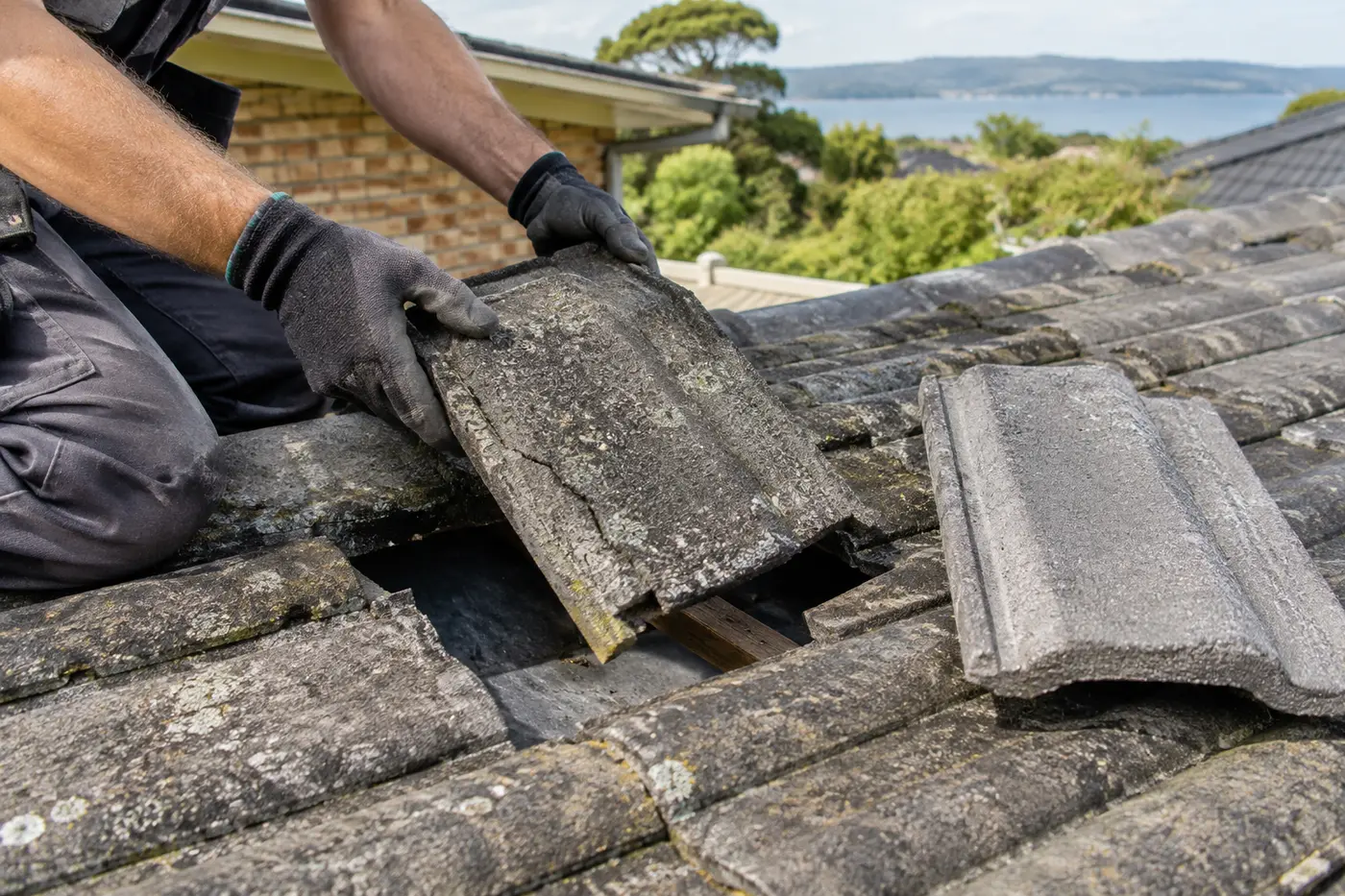
A tile replacement done properly is more than dropping in a new tile. We lift the tiles around the broken one, slide it out, and check what was underneath: whether the batten is wet or soft, and whether the sarking (if there is any) has been damaged. Water that has been coming in for a while sometimes means a little more than one tile needs attention.
The neighbouring tiles get a close look as well, since cracks rarely come alone when someone has walked across a roof. Tiles along the ridge, hips and edges are held in place with mortar bedding, so replacing one of those means rebedding it and repointing to lock it down again.
When we take on a job through our Central Coast roof repair service, we photograph the broken tiles before and after, so you can see what was done on a part of the house you will probably never look at yourself.
Silicone over a crack is not a repair
We see a lot of this. Someone runs a bead of silicone or sealant along a cracked tile, the drip stops, and the job is forgotten. It usually holds for a season. Then the sealant lets go at one edge, water gets in behind it, and the patch traps that water against the tile instead of letting it drain. In Toukley, where generations of capable owners fixed things themselves, we meet silicone over cracked tiles almost weekly.
A cracked tile cannot be made whole again. Replacing it is the fix you only pay for once.
When a few cracked tiles point to bigger work
Most of the time a broken tile is a genuine one off: someone stepped in the wrong place, a branch came down, and replacing a handful of tiles sorts it. If that is your situation, you can see what broken tile and leak repairs typically cost on the Coast before you call anyone.
Sometimes the inspection tells a different story. If tiles are cracking all over the roof, crumbling at the edges or soaking up water like a sponge, the problem is the age of the tiles rather than one bad step. Replacing them one at a time becomes a job that never ends. That is when we talk about a full restoration, or for roofs that are past it, a replacement. We will show you the photos either way and let you decide.
Get the cracked tile sorted before the next storm
If you have spotted a broken tile, a piece in the gutter or a new stain on the ceiling, it is a small job to fix now and a bigger one to fix after a winter of rain. Our inspections are free, and we will give you a written quote with photos of what we found. Call Roof Restorations & Replacements Central Coast on (02) 4326 0722 (NSW Licence #203374C), Monday to Saturday 7am to 5pm, or book through our roof repairs page.