Picture the last big southerly that rolled through. Wind-driven rain works its way under a couple of lifted tiles, and a week later you notice a faint brown ring spreading across the bedroom ceiling. The tiles look perfectly fine from the ground, so what happened? Often the answer is what is missing underneath them. On a lot of older Central Coast homes there is nothing between the tiles and your ceiling but a gap of air. Roof sarking is the thin membrane that is meant to sit in that gap, and whether or not your roof has it makes a genuine difference to how it copes with our weather.
The layer of your roof you never see
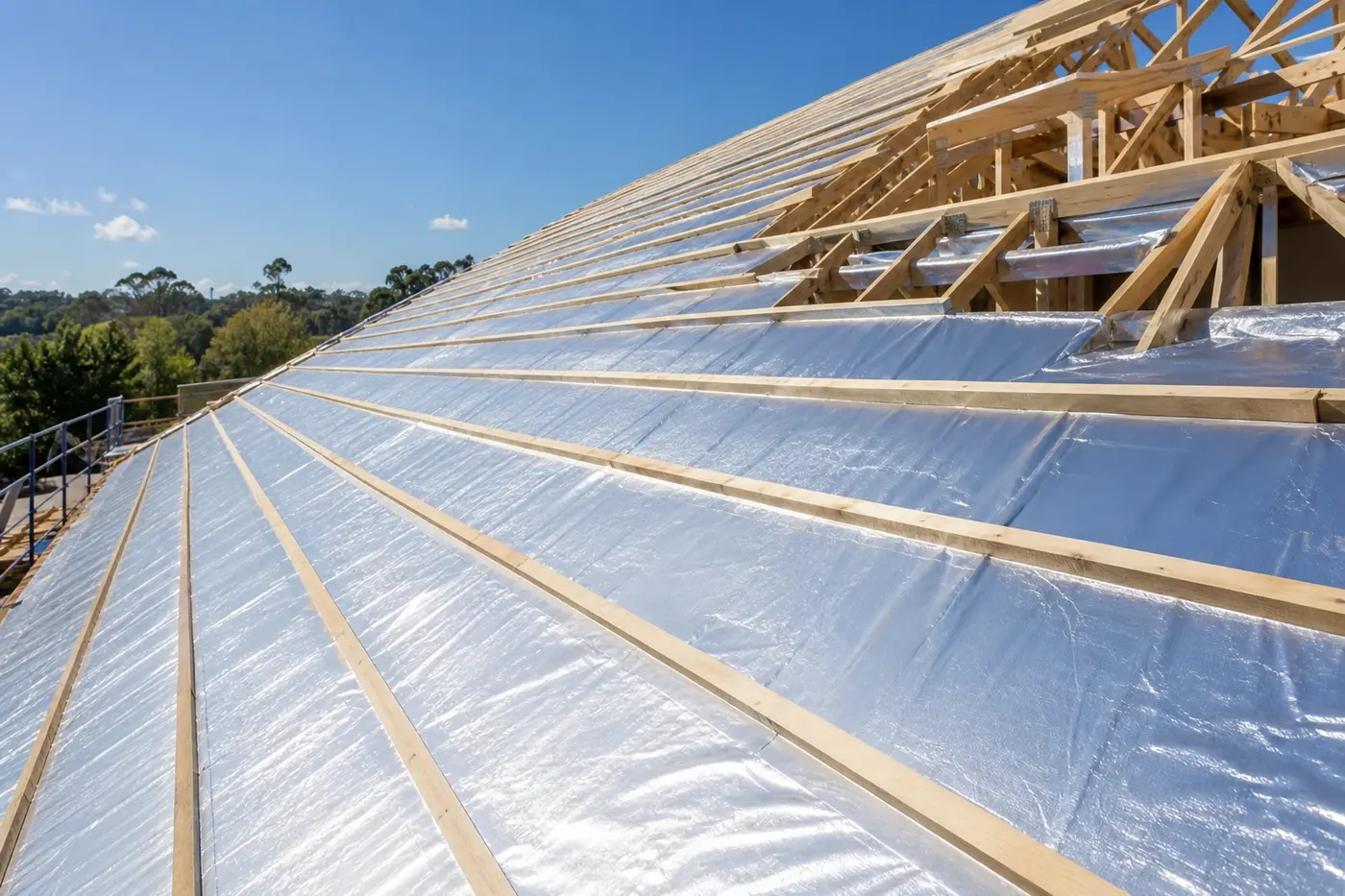
Sarking is a flexible, foil-faced membrane that gets rolled out across the rafters or trusses before the tiles or metal sheets go on. Think of it as a second skin under the roof covering. It is not the roof itself, and it is not the fluffy batt insulation that sits on your ceiling. It lives between the two, draped just under the tiles or sheets, doing a quiet job that most homeowners never think about until something goes wrong.
Here is the part that surprises people: plenty of homes built before the 1990s have no sarking at all. If your roof went on decades ago and has never been touched since, there is a fair chance the only thing standing between wind-driven rain and your ceiling is the tiles themselves. That works fine right up until it doesn't.
What sarking does for a home on the coast
We deal with a specific kind of weather up here. Humid summers, salty air off the water, heavy downpours and the odd wild storm. Sarking earns its keep against all of it, in a few different ways.
- It catches water the roof lets through. No tiled roof is completely watertight in a driving storm. Rain can be blown up and under the tiles, and condensation forms under metal on cold nights. Sarking catches that stray water on its surface and channels it down to the gutter, instead of letting it drip onto your insulation, timber and ceilings.
- It reflects heat. The foil face bounces a good deal of the radiant heat coming off a hot roof back out, so less of it soaks into your roof cavity. On a dark roof in February, that matters for how the upstairs rooms feel.
- It keeps dust and embers out. Sarking seals up the small gaps around the roof covering, which keeps windblown dust and grit out of the roof space. In bushfire-prone pockets of the Coast it also blocks burning embers from getting in, which is why it is required in those areas.
That condensation point is worth dwelling on for metal roofs in particular. Bare steel with no membrane under it will sweat on the underside on a cold, still night, and that moisture drips back down over time. Pairing sarking with proper airflow is the fix, which is where roof ventilation and whirlybirds come into the picture alongside it.
Is sarking required, or just a good idea?
For a lot of new work these days, it is both. Modern roofing to the Australian standard for pliable membranes (AS/NZS 4200) generally includes sarking, and in designated bushfire-prone areas it is not optional. Councils across the Central Coast take bushfire attack levels seriously, so if your place sits in one of those zones, a compliant re-roof will include sarking as a matter of course.
Older homes are a different story. If yours was built without it, you are not breaking any rule by leaving things as they are. The roof is not going to fall in tomorrow. But every storm season you are relying on the tiles alone, and once you have had one leak trace back to the lack of a membrane, the value of that quiet extra layer becomes obvious.
Can you add sarking to a roof you already have?
This is the question we get most, and the honest answer is: only really when the roof covering comes off. Sarking sits under the tiles or sheets, so laying it means lifting the entire roof surface, rolling out the membrane, and putting the covering back. Doing that on its own, purely to add sarking, rarely stacks up on cost.
The sensible time to add it is when the roof is already coming off for another reason. If you are booking a full roof replacement, the sarking goes in as part of the job, with barely any extra labour because the tiles or sheets are off anyway. The same goes if you are switching from tiles to a metal roof, which is the ideal moment to build sarking into the new roof from the start. You are already paying for the access and the set-up, so adding the membrane is a small extra that protects the much larger investment sitting on top of it.
Foil or breathable: which sarking is right
There are two broad types and the difference matters. Reflective foil sarking is the traditional choice. It blocks radiant heat well and stops dust, but it does not let water vapour pass through, so it needs good roof ventilation working alongside it to avoid trapping moisture. Vapour-permeable sarking is the newer option. It still keeps liquid water out but lets internal water vapour escape, which lowers the risk of condensation building up in the cavity. For a humid coastal climate, the breathable type is often the smarter pick, though the right call depends on your roof type and how well your roof space breathes. That is the sort of thing worth talking through before the job, not after.
Talk it through before you re-roof
If a re-roof or a tile-to-metal conversion is on the cards for your place, sarking is one of those small decisions that is easy to get right at the start and expensive to fix later. We are a licensed local team (NSW Licence #203374C) and we back our roofing work with a 15-year warranty, conditions apply. Give us a call and we will come out, take a proper look at your roof and roof space, and tell you plainly whether sarking is worth including in the work you are planning. No pressure, just straight advice from someone who works on Central Coast roofs every week.