It usually starts as a faint brown ring on the plaster around the skylight shaft. Then one wet week there is a drip on the kitchen bench, right under the light well, and a towel becomes a permanent fixture. Skylight leak repair is a job we do regularly on Central Coast homes, and the good news is that most of them are fixed without touching the skylight itself.
Before anyone gets on the roof, though, it is worth knowing which kind of drip you have. Not every wet skylight is leaking.
Some skylight drips are not rain at all
Condensation fools a lot of people. Warm, moist air from a kitchen, bathroom or laundry rises up the shaft, hits the cold dome and turns back into water. On a chilly morning it can run down the inside and drip as steadily as any leak.
The giveaway is the weather. If the drips turn up on cold, dry mornings and you can see beads of water on the inside of the dome, it is almost certainly condensation. That is a ventilation problem in the room below, not a roof fault, and a roofer is not the first call.
A real leak behaves differently. It appears during or after rain, often worse when the wind is blowing hard from one direction, and it leaves a stain that grows or a tide mark on the shaft lining. If that sounds like yours, read on.
The dome usually outlasts the flashing around it
A skylight is a hole cut through the roof, and every hole in a roof needs flashing: the metal skirt that seals the join between the skylight frame and the tiles or sheets around it. In our experience the dome itself usually outlasts its flashing kit, so when a skylight leaks, the flashing is the first thing we look at.
These are the spots we find the water getting in most often:
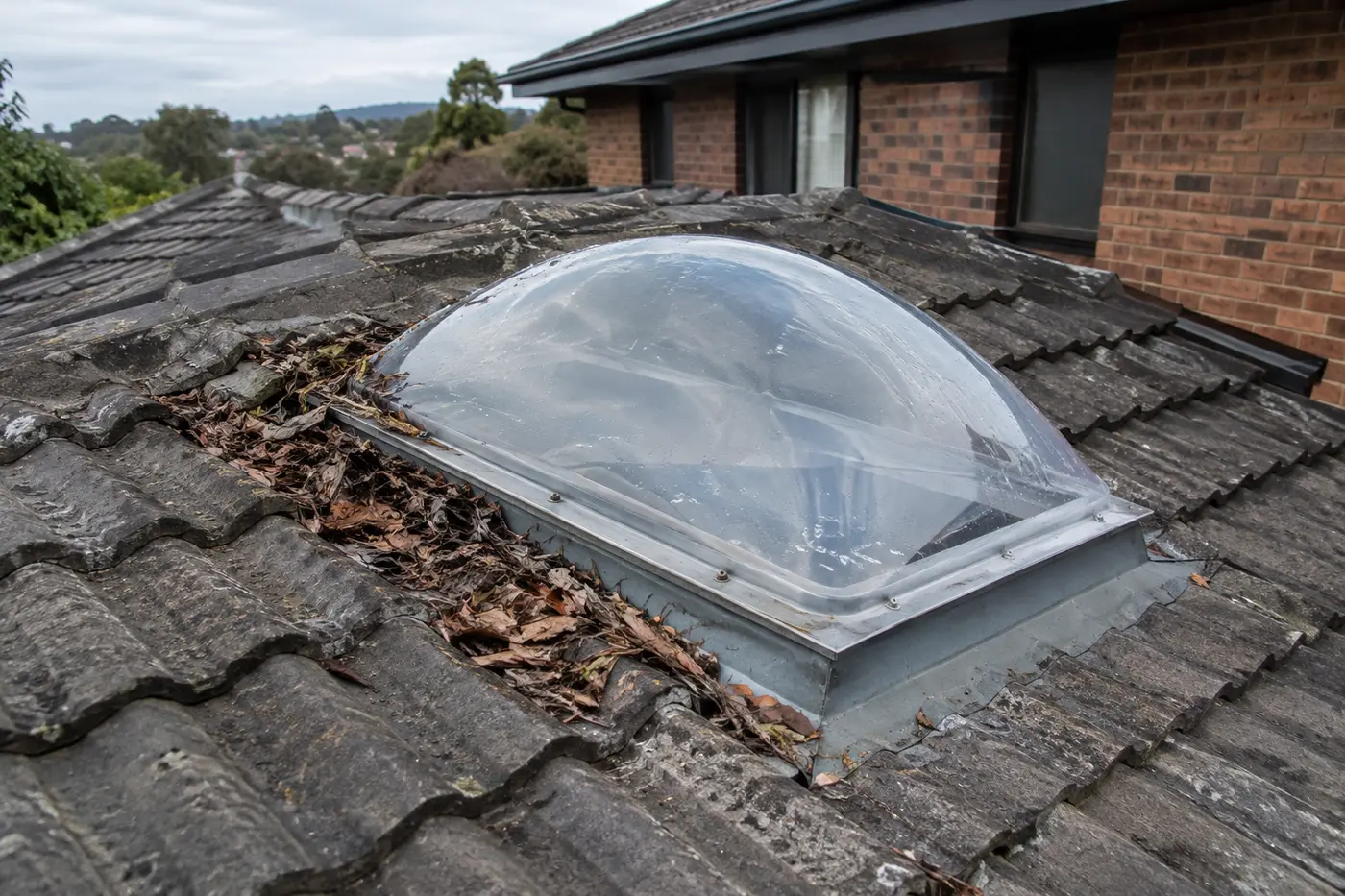
- The uphill side, where leaves and grit bank up against the frame and hold water there after every shower
- The side flashings, where they have lifted, rusted or pulled away from the tiles
- Tiles around the opening that were cut or cracked when the skylight went in
- The seal between the dome and its frame, once the rubber has hardened in the sun
Age is the big factor. A lot of skylights went in on 1990s two storey homes in suburbs like Erina, and those flashings are now reaching exactly the age where they fail. They tend to fail quietly, too, leaking into the ceiling cavity for months before a stain ever shows.
Skylight flashing faults have a lot in common with the ones we find on chimneys and walls. If the leak is somewhere else on the roof, our guide to roof flashing problems covers those.
The stain is not always under the skylight
Water rarely drops straight down from where it gets in. It runs along battens and rafters first, so a skylight leak can show up a metre or more away from the shaft. The reverse happens too: a cracked tile or a blocked valley uphill can send water down the roof that only surfaces at the skylight, because the shaft is the first gap it finds.
That is why skylight leaks are often misdiagnosed as tile problems, and tile problems as skylight leaks. A proper inspection starts at the stain inside, then checks the skylight, its flashing and everything uphill of it before anything is fixed. Replacing a skylight that was not the cause leaves you with a new skylight and the same leak.
Reflashing fixes most leaks. A tired dome changes the answer
If the dome is clear and sound, the usual fix is to reflash it. That means lifting the surrounding tiles, removing the old flashing, fitting new flashing lapped the right way, and relaying the tiles so water is steered around the frame and back onto the roof. Any cracked tiles around the opening get replaced while we are there.
If the acrylic has yellowed, gone brittle or cracked, that changes things. Reflashing a dome that is near the end of its life only buys time. In that case we quote a replacement alongside the repair, because the access is already set up and doing both at once saves real money compared with two separate visits.
One thing we would steer you away from is a tube of silicone around the frame. It might hold for a season. Then it splits, traps water against the frame instead of letting it drain, and the leak comes back worse. A surprising amount of our roof repair work across the Central Coast is fixing earlier patch jobs exactly like that.
What a skylight leak repair costs
Most skylight leaks are flashing jobs, and our indicative range for flashing repair or replacement is $350 to $800. Where the leak first needs tracing, leak detection plus the repair is typically $300 to $900. These are indicative ranges only, and every job is quoted in writing after a free inspection.
A few things push a quote towards the top of the range. Two storey roofs take more time and safety gear. A skylight with several cracked tiles around it, or a second fault uphill, means more work. A full skylight replacement is priced separately once we have seen the dome, the frame and the size of the opening. For a broader picture of what different leaks cost to fix, our roof leak repair price guide sets out the full list.
A slow leak still does damage
A skylight leak that only drips in heavy rain can feel like something to deal with later. The problem is what happens between the drips. Every wet spell soaks the same plaster, insulation and timber around the shaft, and those repairs are separate from the roof work. The roof fix might stay modest. The damage inside does not.
If you have a stain around the skylight that is growing, or the shaft lining is bubbling or sagging, it is worth getting it looked at before the next run of storms.
Get the skylight checked properly
Call Roof Restorations & Replacements Central Coast on (02) 4326 0722 (NSW Licence #203374C), Monday to Saturday, 7am to 5pm. We will trace where the water is really getting in, show you photos of what we find, and give you a written quote for skylight and leak repairs after a free inspection.