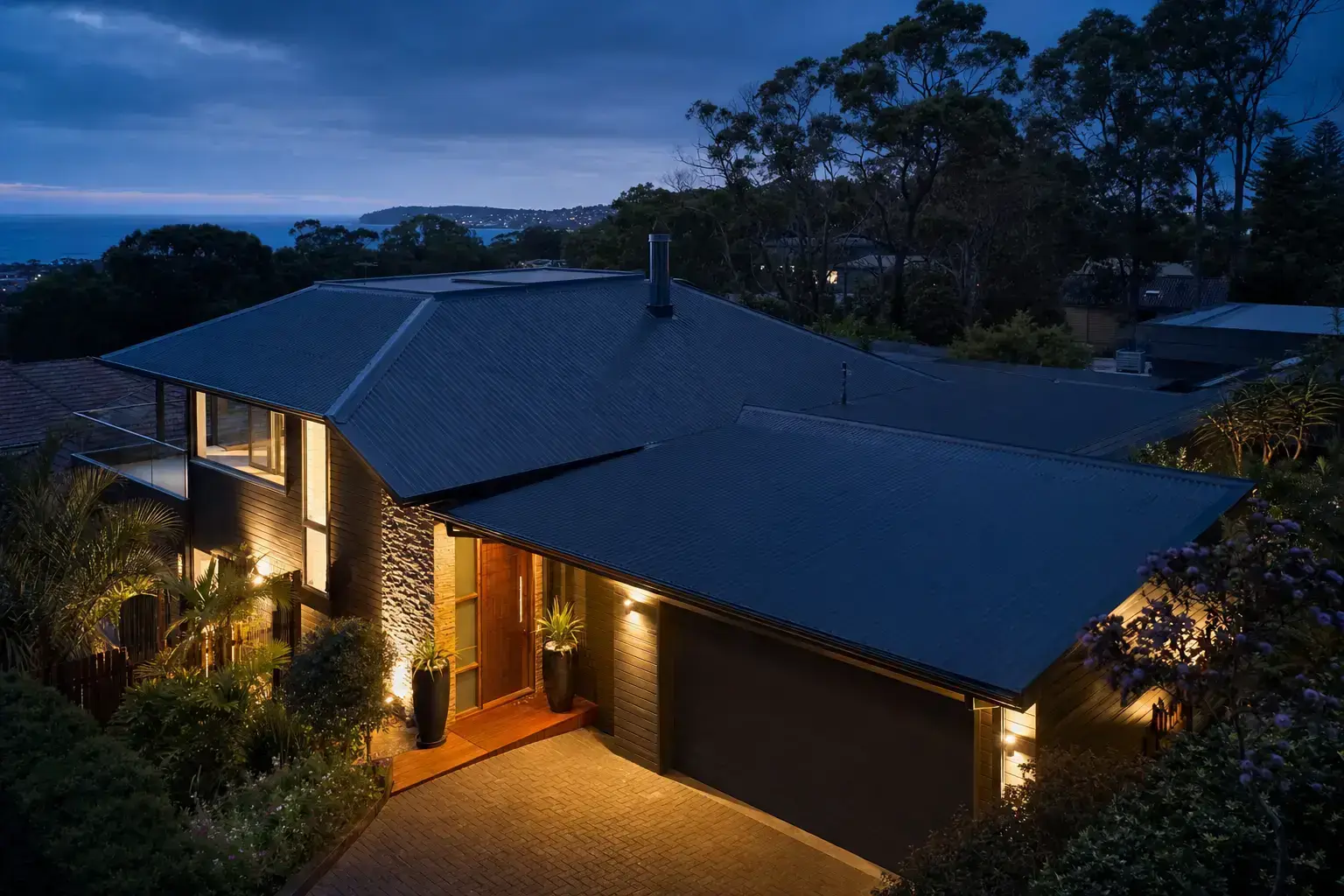
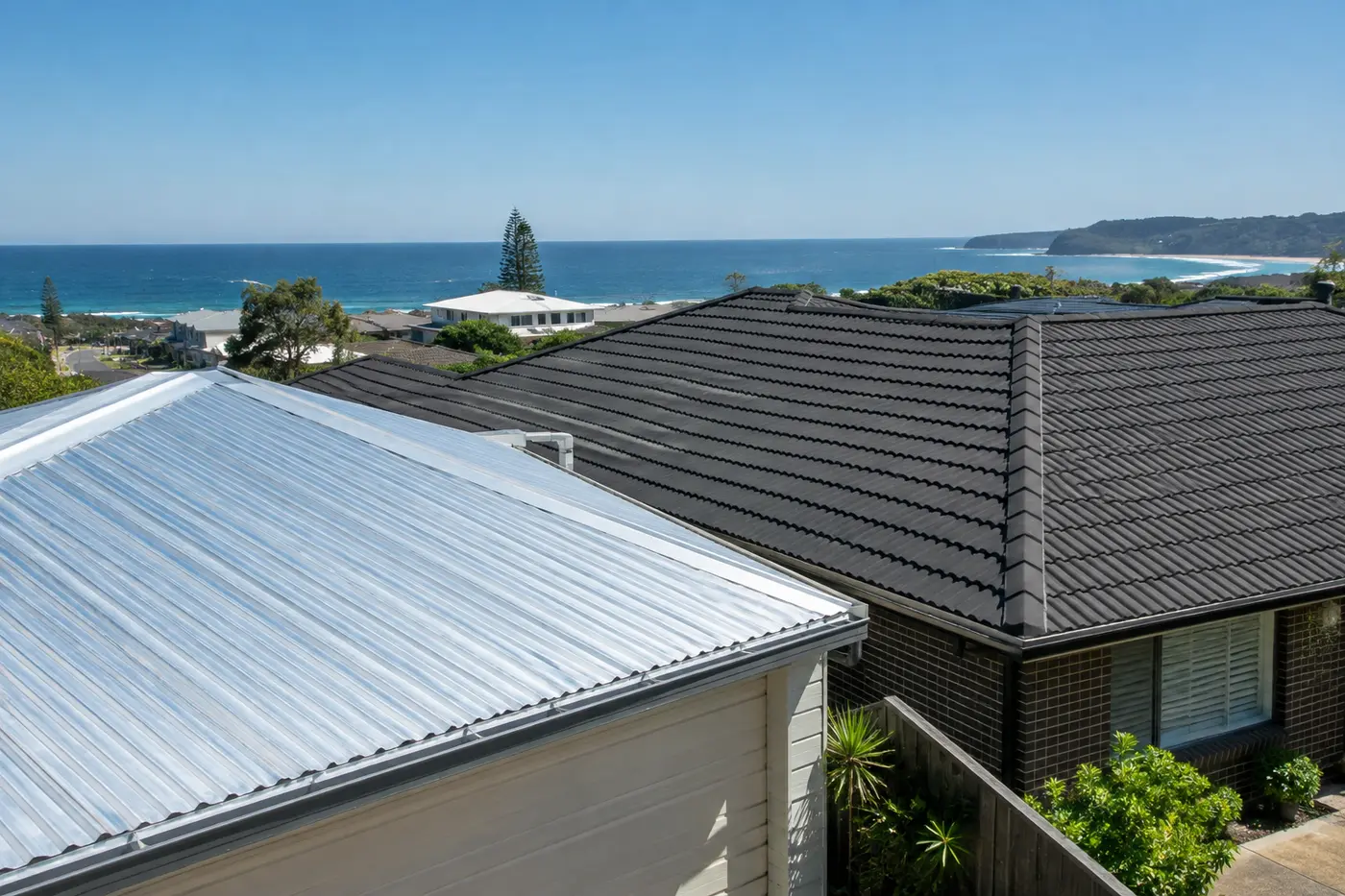
You have finally decided the old roof has to go. The quote arrives, and halfway down the page there are two options side by side: Zincalume and Colorbond. One is cheaper. Both are steel. Both sound fine. So which one should go on your house? We get asked about Zincalume vs Colorbond on almost every metal roof we quote, and the honest answer depends less on the brochure and more on where your home sits, who can see your roof, and how long you plan to stay.
Same steel underneath, a different finish on top
This is the part most people don't realise. Both products are made by BlueScope, and they start life as the same thing. Zincalume is steel with a metallic coating of aluminium and zinc, which is what protects it from rust. That coating gives it the silver look you see on sheds and farm buildings.
Colorbond is that same Zincalume coated steel with extra layers added on top: a pretreatment, a primer and a baked paint finish. So you are not choosing between two different metals. You are choosing whether your roof gets a paint system over the protective coating, or goes up bare.
It is also worth clearing up one mix-up we hear a lot. The dull grey corrugated iron on old sheds and outhouses is usually galvanised steel, which has a zinc-only coating. Zincalume replaced it for most roofing work, and it is a different product.
The price gap is smaller than most people expect
Zincalume typically runs 10 to 15% cheaper sheet-for-sheet. That sounds like a solid saving until you remember the sheets are only one part of a roof job. Taking off the old roof, the labour to install, the flashings, sarking, screws, gutters and any carpentry repairs cost about the same whichever finish you pick.
So the difference on the total invoice is a smaller slice than that sheet price suggests. For a shed or a carport, where materials are a bigger share of the cost, the saving counts for more. On a whole house, most of our customers decide the gap isn't big enough to be the deciding factor. If you are still at the earlier stage of weighing up whether to move off tiles at all, our guide to converting a tile roof to metal covers that decision first.
Salt air matters more than the colour choice
Here on the Coast, this is the factor we spend the most time on. Both Zincalume and Colorbond handle salt far better than old galvanised iron, but neither is immune to it. A house a street back from the beach at Avoca or Wamberal lives in a very different environment to one up the hill in Kariong or Narara, and the roof should be specified to match.
The trick with salt is that rain is actually your friend. On the open parts of the roof, every downpour washes the salt off. The trouble spots are the sheltered areas that never get rinsed: under a second storey overhang, beneath the eaves, behind a parapet or tucked under a patio roof. Salt builds up there, holds moisture against the steel and slowly works on the coating. We see this far more often than failures out on the open roof.
For homes close to the surf, the grade of steel matters as much as the finish. We match the grade to your distance from the water and use sealed, marine-rated fasteners on exposed sites. For the harshest beachfront spots there is Colorbond Ultra, a tougher grade made for severe marine conditions. A quick hose down of those sheltered sections every so often also goes a long way.
Zincalume is bright, and your neighbours will notice
A brand new Zincalume roof is shiny. On a sunny morning it can throw real glare, and on the Central Coast, where plenty of homes sit on slopes looking down over the rooftops below, that glare lands in someone's living room. It softens to a duller, even grey as it weathers, but that takes time.
Some councils and housing estates have rules about highly reflective roofing for exactly this reason. If your roof is visible from homes above you, or you are in a newer estate with design guidelines, check before you commit to Zincalume. Colorbond sidesteps the question because the paint finish cuts the glare.
Heat comes down to how light the roof is
People often assume the silver roof must be the coolest. When Zincalume is new it does reflect a lot of sunlight, but as it dulls it loses some of that edge. A light Colorbond colour holds its reflectivity for much longer, while a dark Colorbond colour will soak up more heat than either.
So if keeping the upstairs rooms comfortable through February is high on your list, the shade you choose matters more than the product name. Our guide to picking a Colorbond colour for coastal heat goes through the popular shades one by one. And whichever finish you choose, what goes under the sheets counts too. New sarking is standard on our replacements, and an insulation blanket under metal makes a measurable difference to summer heat and rain noise.
They age in very different ways
They age differently, and it is worth picturing that before you choose.
Zincalume starts bright and settles into a soft grey. Because there is no paint, a scratch from a ladder or a dropped tool simply blends in over time. What you see in year one is not what you will see later, so if you love that crisp silver, know that it won't stay crisp.
Colorbond holds its colour well, but the paint does slowly fade and chalk over the long haul, with darker colours showing it sooner. Scratches show against the colour and need a touch-up. The upside is that a tired Colorbond roof can be repainted years down the track to freshen it up, and you get to pick the colour that suits your house in the first place.
Mixing them is fine, but some metals are not
Plenty of homes end up with both. Colorbond gutters and fascia on a Zincalume shed, or a Colorbond house roof with a Zincalume patio out the back, is completely normal. The two are compatible because they share the same base.
The problems start with dissimilar metals. Copper and lead are the usual culprits. Water running off an old copper pipe, or across old lead flashings, onto either product will eat into the coating over time. This is called galvanic corrosion, and it is invisible when a roof is detailed properly and a slow failure when it isn't. It is one of the things we check on every inspection, and it is why a new roof often gets new flashings rather than reusing the old ones.
Where we would put each one
For homes, we usually recommend Colorbond for looks and warranty. It suits the street, it gives you a colour to match your walls and trim, it cuts the glare question out entirely, and the gap in price across a whole job is modest.
Zincalume earns its place in a few specific spots:
- sheds, garages and carports where cost matters more than colour
- rural buildings and outbuildings on bigger blocks
- patio and pergola roofs out the back, away from the street
- older cottages where the traditional silver roof is part of the character
For sheds and rural buildings, Zincalume is the smart saver. For the house itself, it is usually worth the modest extra. If you want to see how we approach Colorbond and Zincalume roofing installs, including repairs to existing metal roofs, that page runs through the work we do across the Coast.
Get a straight answer for your address
The right choice changes from one street to the next, so the best way to settle it is to have someone look at the house, the roof lines and how close you are to the water. Our roof inspections are free and come with no obligation, and our work carries a 15-year warranty (conditions apply). Call us on (02) 4326 0722, Monday to Saturday from 7:00am to 5:00pm, or read more about our metal roofing service and book a visit.